Thermoforming vs Injection Molding: Choosing the Right Process
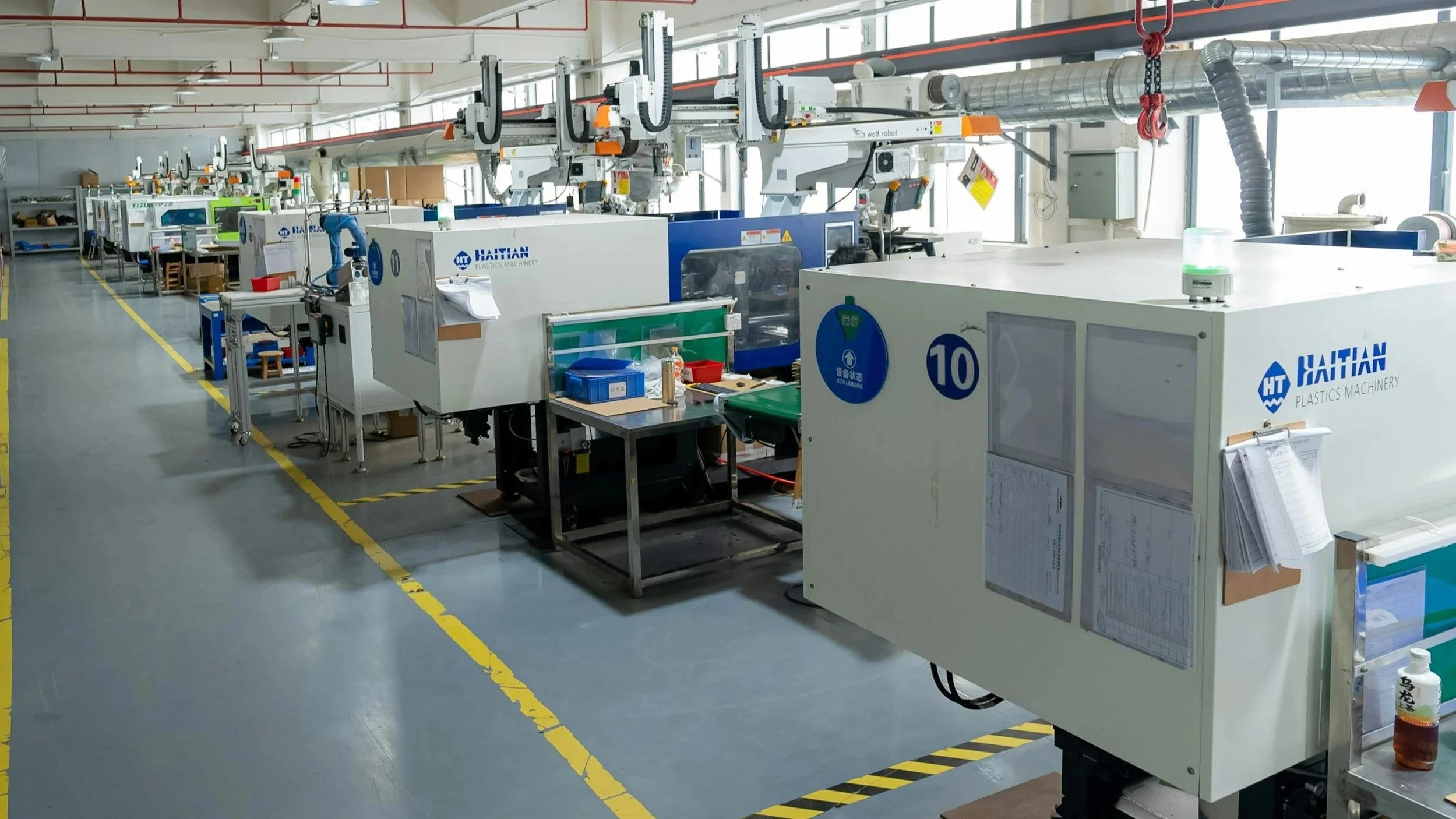
Thermoforming and injection molding are two of the most widely used plastic manufacturing processes. Choosing between them is a decision that shapes everything from your unit economics to your time-to-market. When a client comes to us with a plastic component challenge, one of the first questions we ask isn't about the part itself; it's about the context around it. For instance, we might ask:
How many units?
How fast do you need to move?
How complex is the geometry?
What does this need to cost at scale?
Those questions matter because the answer almost always points toward one of these two processes. Both are proven, widely used, and capable of producing high-quality components. But they are built for fundamentally different situations, and choosing the wrong one (even with the right design) creates real problems downstream. Higher costs than necessary, longer lead times than expected, or a production process that simply can't scale the way your business needs it to.
The SI Jacobson Manufacturing team believes that the best manufacturing decisions start with understanding, not assumptions. So before we propose a process, we want to understand what you're trying to accomplish from an operational, financial, and product standpoint. Whether you're early in the design phase or re-evaluating an existing production setup, understanding the thermoforming and injection molding processes gives you a stronger foundation for making a long-term choice that serves your product and your business.
What Is Thermoforming, and When Does It Make Sense?
Thermoforming is a plastic manufacturing process used to create 3-dimensional components. The process begins with a flat thermoplastic sheet that is heated until pliable, then stretched over a single-sided mold using vacuum or mechanical pressure to take its shape. The plastic is then stretched over a mold using mechanical or vacuum pressure to create the desired shape or part. Afterward, the sheet is allowed to cool until it solidifies. Once the component is molded, it is removed and trimmed to the specified dimensions. Secondary CNC machining can be added afterward to incorporate more detailed features without introducing stress points or weak spots into the material.
Advantages of Thermoforming
The main advantages of thermoforming include:
Low setup costs: Because thermoforming uses single-sided molds, tooling requirements and their associated costs are significantly lower than those of injection molding. That lower barrier to entry means faster time to market and more room to iterate during development.
Design flexibility: Thermoforming excels with large-format components, including appliance doors, vehicle panels, and display kiosks. Meanwhile, other processes would require impractical molds and a high cost. Detailed features can be incorporated through secondary CNC machining without introducing weak spots or stress points.
High production speed: For small batches and prototyping, thermoforming enables faster setup and quicker turnaround than most alternative plastic manufacturing processes, which matters when development timelines are tight.
Disadvantages of Thermoforming
Thermoforming also has a few drawbacks, including:
Lower production volumes: As volume scales up, per-unit economics shift unfavorably. Thermoforming is not well-suited for applications requiring high-volume, continuous production runs.
Limited design complexity: For components requiring tight tolerances or highly intricate geometry, thermoforming can't match the precision of other methods.
Thermoforming is associated with low upfront costs and quick turnaround times. It is widely used to manufacture large, complex plastic parts at lower production volumes. The method is commonly applied in the production of display kiosks, appliance doors, and motor vehicle panels.
Everything You Need To Know About Injection Molding
Injection molding uses a controlled heating and injection process to transform thermoplastic pellets into precise plastic components. In this custom plastic manufacturing process, molten pellets are injected under high pressure into a closed mold cavity. The molten plastic fills the mold and takes its exact shape before cooling to a solid. Overall, this leads to a product that is dimensionally consistent and repeatable across thousands or millions of cycles.
Advantages of Injection Molding
The main injection molding advantages include:
Material variety: Injection molding supports a wide range of thermosets and thermoplastics, giving engineers flexibility to specify materials based on mechanical performance, chemical resistance, or regulatory requirements. This makes injection molding adaptable across industries and applications.
Cost-efficient at scale: Per-unit injection molding costs decrease substantially as production volume increases. For high-volume molding of automotive components, medical devices, consumer electronics housings, and precision industrial parts, the economics become compelling at scale.
High-precision production: Once a mold is built and validated, injection molding produces complex parts with tight tolerances at speeds and with consistency that few other custom plastic manufacturing processes can match. Geometry that would be difficult or impossible to achieve otherwise becomes repeatable and reliable.
Disadvantages of Injection Molding
The main drawbacks of this method include:
Higher setup costs: Double-sided 3D molds require significantly more engineering and investment than thermoforming tooling, making upfront injection molding costs a real consideration for new products or low-volume runs.
Design limitations: Mold geometry can constrain certain design features, requiring close collaboration between design and manufacturing teams early in the process.
Longer lead times: Complex molds take time to engineer and produce, which can delay getting new products to market if development timelines aren't planned accordingly.
This plastic manufacturing method offers unmatched repeatability and dimensional accuracy. It is well-suited for producing components that require superior mechanical properties and precise tolerances. Common applications of injection molding include the manufacture of intricate automotive components, medical devices, consumer products, electronic housings, and autonomous robotics.
Choose the Right Custom Plastic Manufacturing Process
Thermoforming and injection molding are popular plastic manufacturing processes. When choosing between them, consider a few essential factors, including the project budget, component size, aesthetic standards, and production volume. Choose thermoforming for low-volume plastic production. For high-volume molding of components with intricate designs, injection molding can be a better option. Decision makers should also weigh the advantages and disadvantages of each method before choosing the right option. This way, they can align their project requirements and goals with the method that offers production efficiencies and quality.
Ready to start producing high-quality custom plastic components? Contact the team at SI Jacobson Manufacturing.